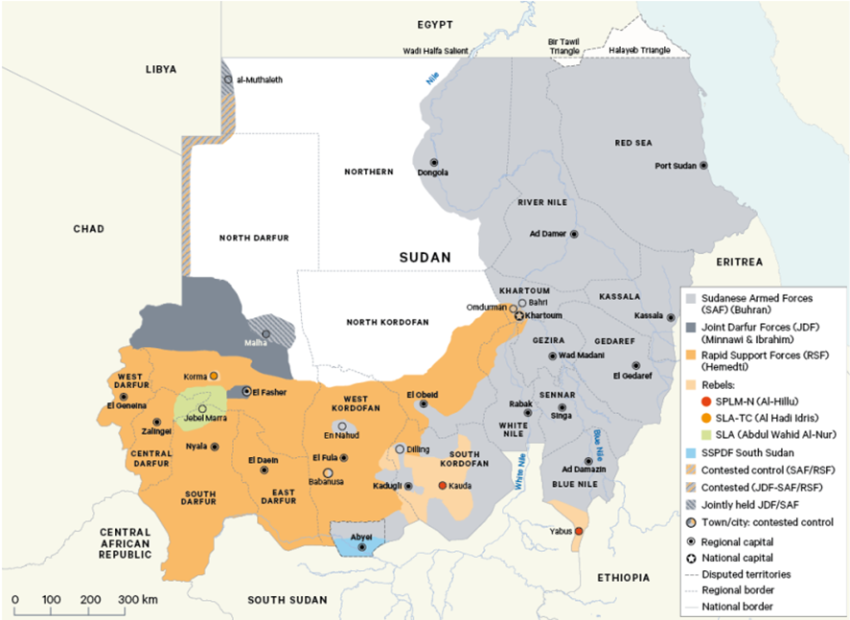
For a third time since its independence in 1956, civil war in South Sudan has broken out, and now it faces the current largest humanitarian crisis in the world.
The Rapid Support Forces (RSF) and Sudanese Armed Forces (SAF) are fighting a civil war in Sudan to fill the power vacuum left behind after the failed 2023 peace agreement between the two groups, which was after the 2021 coup by the SAF. The 2 organizations have a history of atrocities committed against the Sudanese people, particularly in the Darfur region. The country has to face the largest humanitarian crisis in the world, with over half of its population facing famine and mass displacement.
Knowledge of the historical instability of Sudan is critical to understanding the events of the civil war.
Sudan first gained independence in 1956 and was immediately plunged into a civil war between the Muslim Arabic north and the black Christian south that lasted until 1972. This civil war resulted in over 500,000 deaths and mass displacement. Both death and displacement would be common elements in future Sudanese crises.
The second Sudanese civil war involved the same two factions from the first civil war and lasted from 1983 to 2005. This time it resulted in the black Christian population breaking away to form the country of South Sudan. Consequently, it caused more deaths and displacement than the first civil war.
Most notable was the genocide of various ethnic groups in the western Darfur region of Sudan. According to The Social Science Research Council, the Danagla, Daju, Jaaliyiin, Zaghwara, Baggara, Shaigiya, and Rizeigat peoples reside within this region.
This genocide was committed by several paramilitary groups but most notably the RSF and, to a lesser but still horrific extent, the SAF both under the rule of then-dictator al-Bashir. The RSF was formed from the Janjaweed militias that were present in Sudan at the time, and their first actions after formation were the genocide in Darfur, establishing an important precedent.
According to the U.S. Holocaust Memorial Museum, 300,000 civilians were killed, 2.7 million were displaced, and a list of atrocities committed include ethnic cleansing, scorching the native land, looting of humanitarian aid, mass killings, and usage of rape as a weapon of war.
The genocide started during the second civil war in 2003 and formally ended in 2005; however, the violence in the region didn’t stop until 2020.
In 2019, a coup attempt led by the RSF and SAF overthrew the dictator, Al-Bashir, and a transitional government was installed to move Sudan to democracy. In 2021, a coup led by the SAF leader, Abdel Fattah al-Burham, overthrew the transitional government, and the RSF leader, Mohammad Hamdan “Hemedti” Dagalo, was upset by this power imbalance between the two groups.
A treaty between them was set to be signed in 2023, integrating the RSF into the Sudanese military and resolving tensions, but the RSF withdrew on March 11th, 2023, due to disagreements, consequently kicking off the civil war in the Sudanese capital, Khartoum.
Since the start of the war, the genocide in Darfur was revived by the RSF, and the aforementioned atrocities are now being committed again in the region.
Several humanitarian disasters have started since the war, including the proliferation of famine across the country. Eighteen million are currently in a state of famine, with the highest famine rates in the Darfur region.
Outbreaks of Cholera and Measles have ravaged the country. These disease outbreaks are becoming increasingly worse as around 80% of the hospitals in Sudan are now out of service due to the civil war. In Darfur and in the major cities, hospitals are virtually wiped out, and the citizens are in dire need of aid.
Food, water, and fuel are extremely low in the country. Any aid that is being sent to Sudan is being looted by the RSF, SAF, or rogue gangs. Several countries, such as China, The United Arab Emirates, and Russia, have been accused of sending weapons to both warring factions, prolonging the war.
Sixteen million displaced Sudanese people, and 4.1 million refugees have been victims of these catastrophic events. This makes it the largest refugee and displacement crisis in African history.
Outbreaks of AIDS have spread through refugee camps. Surrounding countries, such as Chad and South Sudan, do not have the proper resources to provide for the refugees. Malnutrition, a lack of water, and human trafficking are present issues in these refugee camps, particularly in Chad.


Posted on November 11, 2025 by thetigertimes
0